Normalisers will gain nothing from their ties with Israeli occupation
Member of Hamas’ Arab and Islamic Relations Office Ezzat al-Resheq condemned the race by some Arab regimes to normalise ties with Israeli occupation as “major sin,” calling on Arab populations and institutions to fight off such move.
Dec 14, 2020 pm31 07:39 pm

Member of Hamas’ Arab and Islamic Relations Office Ezzat al-Resheq condemned the race by some Arab regimes to normalise ties with Israeli occupation as “major sin,” calling on Arab populations and institutions to fight off such move.
In a speech marking 33rd Hamas anniversary, al-Resheq stressed that normalisation with the Israeli occupation cannot be marketed as serving Palestinian interests.
“Hamas wants the Arab and Muslim world not to fall into the swamp of normalisation and fight off all attempts aimed at weakening them and undermining their resources,” al-Resheq added.
‘Loyal to Palestine’
Al-Resheq stressed that the Arab and Muslim public would remain loyal to Palestine and its just cause and supportive of the Palestinian people and their right to liberate their lands and holy sites.
The senior Hamas official hailed the Arab and Muslim peoples who took to the streets to protest normalisation with the Israeli occupation and reiterate their support for the Palestinian cause.
‘It won’t change struggle equation’
“Betting on the sitting or the coming American administration won’t change the equation of the struggle with the Israeli occupation,” al-Resheq stressed. “Any gains that the Israeli occupation government made through forced normalisation won’t continue and won’t be of any strategic significance.”
Al-Resheq added that the wave of normalisation between some Arab states and the Israeli occupation is a “loss for the Palestinian cause.”
Normalisation, al-Resheq continued, serves only the Israeli occupation’s agenda and racist policies in Palestine and the region.
Openness to all sides
The member of Hamas Politburo emphasised that his movement was using its “political flexibility, awareness, and wisdom and the fairness of its cause” to manage its political relations with the Arab and Muslim nations, without getting involved in any regional dispute.
Al-Resheq confirmed that Hamas has built “balanced and moderate” ties with the Arab and Muslim nations at the official and popular levels.
“Hamas was and is still a Palestinian national liberation movement that has one goal in common with all Arab and Muslim states – serving the Palestinian cause and defending it and supporting its people and their legitimate struggle,” al-Resheq continued.
He pointed out that Hamas has never been hostile to any side and will always be open to any relations that serve the Palestinian interests and rights, adding that his movement “is extending its hand to all Arab and Muslim countries to boost cooperation in a way the serves the Ummah’s first issue against their joint enemy.”
However, al-Rasheq continued, developing ties with Arab and Muslim nations depends on their stances towards the Palestinian cause.
Over the past years, Hamas has managed to maintain “positive” relations with the Arab and Muslim world, al-Resheq demonstrated.
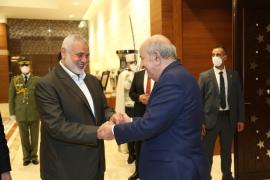
Speaking about Hamas chief Ismail Haniyeh’s recent visit to several countries, al-Resheq said that such move strengthened the movement’s relationship with Tukey, Iran, Qatar, Egypt, Lebanon, and Malaysia.
“Hamas has long-established and rooted ties with all political parties and factions in the Arab and Muslim world,” al-Resheq noted.
Three tracks
To face off the tide of normalisation with the Israeli occupation, al-Resheq highlighted three tracks.
The first track, al-Resheq pointed out, is to end the intra-Palestinian division, achieve national unity, build a true partnership among all Palestinians on the basis of joint national action, and take a national position against normalisation and any attempt to waive Palestinian rights and national constants.
As for the second track, al-Resheq called for activating comprehensive resistance against the Israeli occupation and enhance cooperation with the Arab and Muslim world to fight off normalisation with all political, diplomatic, media, economic, charity, humanitarian, cultural, and academic means.
Al-Resheq pointed out that the third track is to boost political relations with the Arab and Muslim world at the official and popular level, as well as the parliamentary level to pass laws criminalising normalisation and at the level of political and Islamic parties and civil society organisations to form an anti-normalisation front and call for boycotting the Israeli occupation.
“Hamas along with the Palestinian people and all Palestinian factions rejecting normalisation will continue its project to liberate its homeland and holy sites and will remain loyal to its principles, constants and sacred sites,” al-Resheq concluded.
READ: Hamas condemns Ankara terrorist attack, voices solidarity with Türkiye
Related